
Key takeaways
- Compare slippers with wide openings, hook-and-loop straps, closed heels and firm non-slip soles: six easy-on picks for steadier indoor steps around the house.
Finding the best slippers for someone with parkinson’s is less about softness and more about how a slipper behaves during the small, repeated moments of the day: getting it on without bending and fumbling, keeping it on the foot through short, shuffling steps, and trusting it on hard kitchen and bathroom floors. When hand dexterity is limited, laces and narrow openings become daily obstacles. When steps are short and the foot does not lift far off the floor, a loose backless mule can slide, catch, or come off entirely. The slippers that work best in this situation share a practical set of design features: wide openings that let the foot enter without forcing, hook-and-loop straps that can be fastened with one hand or by a caregiver, closed heels that keep the slipper tracking with the foot, and firm, textured soles that stay predictable on smooth indoor surfaces.
This guide rounds up six slippers built around those features, from orthopedic brands and adaptive footwear makers whose catalogs focus on easy entry and secure fit. Every pick below is a real, named model, and every feature mentioned is one the maker lists for that model: an extra-large opening here, a removable footbed there, a non-skid outsole or an adjustable strap. We have kept the focus on design and fit rather than promises, because a slipper cannot treat a condition — but the right design can remove a surprising amount of friction from simply moving around the house.
Quick verdict
If you want one recommendation to start with, the Orthofeet Charlotte is the most complete package for women: the maker lists a wide-opening adjustable strap, a heel lip that helps the foot slide in, a removable orthotic insole with fitting spacers, and a wide toe box, all in a closed bootie shape that stays on the foot. For men, the Orthofeet Asheville applies the same thinking in an adjustable, faux-fur-lined slipper with a closed design. If the single biggest priority is the easiest possible entry, the Propet Cush ‘N Foot — made in both a women’s and a men’s version — uses an extra-large opening with a secure hook-and-loop closure and a stretchable upper, so the foot goes in without pushing or prying. The Dr. Comfort Cuddle is the pick for a padded closed heel and a thick non-skid outsole, and the Silvert’s Adaptive Diabetic Slippers are the widest, most caregiver-friendly option, with Easy Touch closures designed for assisted dressing. Read the full picks below to match each design to the person who will wear it.
Comparison table
| Product | Closure and opening | Sole | Fit notes the maker lists | Best for |
|---|---|---|---|---|
| Orthofeet Charlotte Women’s Slippers | Wide-opening adjustable side strap | Ergonomic sole with mild rocker design | Wide toe box, removable orthotic insole, two fitting spacers | Most complete all-round pick for women |
| Orthofeet Asheville Men’s Slippers | Adjustable strap closure | Cushioned orthopedic sole | Faux fur lining, removable insole design | Men who want warmth plus adjustability |
| Propet Cush ‘N Foot Women’s Slipper | Extra-large opening, hook-and-loop closure | Indoor-outdoor sole | Stretchable neoprene or corduroy upper, removable footbed | Easiest entry for women |
| Propet Cush ‘N Foot Men’s Slipper | Extra-large opening, hook-and-loop closure | Indoor-outdoor sole | Stretchable upper, removable footbed, wide widths | Easiest entry for men |
| Dr. Comfort Cuddle Women’s Slippers | Slip-on with closed heel | Thick non-skid outsole | Padded heel collar, gel inserts included, wide width | Closed-heel security and cushioning |
| Silvert’s Adaptive Diabetic Slippers | Adjustable straps with Easy Touch closures | Slip-resistant sole | Extra-wide fit, polar fleece lining, machine washable | Widest fit and caregiver-assisted dressing |
How we selected
We started from the practical demands of the situation rather than from general bestseller lists. A slipper for someone living with Parkinson’s has to pass a few non-negotiable tests. First, entry: the opening must be wide enough, and the closure simple enough, that putting the slipper on does not require strong pinch grip, two-handed tying, or balancing on one foot while forcing a heel in. Hook-and-loop straps, extra-large openings, and stretch uppers all help here, and every pick in this guide has at least one of those features as the maker lists it. Second, retention: once on, the slipper must stay on through short steps. Closed heels, heel lips, and straps that wrap the midfoot all matter more than plushness. Third, the sole: we looked for firm outsoles with tread or non-skid and non-slip descriptions from the maker, and we favored low, stable profiles over thick, squishy platform soles that can feel unsteady and catch on floor transitions. Fourth, fit flexibility: feet change across the day and across the year, so adjustable straps, removable insoles, fitting spacers, and wide widths earned extra credit.
We also applied strict sourcing rules. Each product below is a real model from an established footwear or adaptive-clothing maker, verified on opened product, catalog, or retailer pages, and each is sold new on Amazon US. Features are described only as the makers list them — where a maker lists a non-skid outsole or an adjustable strap, we say so; we do not claim any slipper improves symptoms, prevents falls, or provides medical benefit. If a model could not be verified on opened pages, it was left out entirely rather than padded with guesses. The result is a short, honest list: six slippers whose designs genuinely suit hands and feet that need dressing to be simple and steps to feel secure.
Top picks
Orthofeet Charlotte Women’s Slippers
The Charlotte is a bootie-style women’s slipper built around one idea: the top opens wide, then closes down to the exact fit the foot needs that day. The maker lists an adjustable strap on a wide-opening design, so the upper swings out of the way for entry instead of asking the wearer to wedge a foot through a narrow collar. A built-in heel lip helps guide the foot in and then holds the heel in place, which matters when steps are short and a loose heel can work its way out of a backless shoe. Once inside, the foot sits on a removable orthotic insole, and the maker includes two fitting spacers so the interior volume can be tuned — spacers in for a snugger fit, out when feet are swollen or when thicker socks are worn.
The upper is suede with a faux fur lining, and the toe box is wide, so toes are not compressed. The sole follows Orthofeet’s ergonomic pattern with a mild rocker design, which the maker lists across its comfort footwear line. For someone with limited hand strength, the strap is the headline: it can be pulled across and pressed down with the palm or with a caregiver’s help, and it can be re-adjusted in seconds when fit needs change between morning and evening. Because it is a closed bootie rather than a mule, the Charlotte also stays with the foot on stairs and during transfers from chair to standing, where an open-back slipper is most likely to be left behind.
Buy it if: you want the most complete combination of wide entry, adjustable fit, closed-heel security, and a removable insole that can make room for an orthotic. Skip it if: the wearer runs warm and would find a fully lined faux fur bootie too hot for year-round indoor wear, or if a fully open-back mule is strongly preferred for sliding on without any strap handling at all.
Orthofeet Asheville Men’s Slippers
The Asheville is Orthofeet’s men’s counterpart in this category: an orthopedic slipper, model S331, with an adjustable closure and a faux fur lining. The adjustable strap serves the same purpose as on the Charlotte — it opens the top of the slipper for an easier entry and then secures the midfoot so the slipper does not rely on toe grip to stay on. That last point is easy to underestimate. In a loose slip-on, the toes instinctively curl to hold the shoe, which is tiring and can change how a person walks; a strap that does the holding lets the foot stay relaxed and flat.
The maker builds the Asheville on its orthopedic platform, with cushioning underfoot and a lining chosen for warmth, which suits men who feel the cold indoors or who wear slippers for most of the day. The closed design gives the heel a defined pocket, and the overall shape is a house shoe rather than a sock-style slipper, so it tracks the foot through turns and short trips across hard floors. Sizing runs through men’s sizes with wide options in the range, and the adjustable strap forgives small sizing misses better than a fixed elastic collar does. For a man who has been shuffling around in worn-out backless slippers, the Asheville is the straightforward upgrade: same daily habit, but with a closure that keeps the slipper attached to the foot.
Buy it if: you want a warm, closed, adjustable men’s slipper from an orthopedic maker, with a strap that does the work of keeping it on. Skip it if: the wearer prefers a lightweight summer-weight slipper, or needs an extra-wide fit beyond what an adjustable strap on a standard last can provide — in that case, look at the Silvert’s pick below.
Propet Cush ‘N Foot Women’s Slipper
Propet describes the Cush ‘N Foot, women’s model W0206, with unusual directness: the upper has an extra-large opening with a secure hook-and-loop closure that makes getting it on and off, in the maker’s words, super easy. That is exactly the feature set this guide is built around. The upper is stretchable — the maker lists neoprene and stretchable corduroy versions, with stretch panels that give over bunions, hammertoes, or simply a high instep — so the foot slides into a soft, forgiving space rather than a rigid shoe shape, and then the single strap closes it down.
Underfoot, the footbed is removable, so a custom orthotic can replace it if one is already prescribed and used in other shoes. Propet offers this model across a wide span of sizes and widths, including extra-wide fittings, which makes it one of the easier slippers to fit precisely. The maker also lists this style under its Ped Rx line and notes its A5500 coding under the Medicare therapeutic shoe benefit for people with diabetes; we mention that only as a catalog fact about the model’s design pedigree — it is built to protective, accommodating standards. For daily wear, the practical summary is simpler: a soft stretch upper, the biggest opening in this roundup, one strap to fasten, and a sole the maker designs for indoor-outdoor use, so a trip to the mailbox does not require a shoe change.
Buy it if: entry ease is the top priority — for example, when bending, reaching, and pulling at a shoe collar are the hardest parts of getting dressed. Skip it if: you want a firm, structured heel counter and a more shoe-like feel; the Cush ‘N Foot’s soft stretch upper is deliberately unstructured.
Propet Cush ‘N Foot Men’s Slipper
The men’s Cush ‘N Foot, model M0202, carries the same design brief as the women’s version into men’s sizing and widths, including extra-wide options that are genuinely hard to find in slippers. The extra-large opening and hook-and-loop strap mean the routine is simple: open the strap fully, place the foot in without forcing, press the strap closed. For men with larger or wider feet, or feet that swell by evening, the stretchable corduroy upper gives room without the sloppy feel of simply buying two sizes up, and the strap restores security after the foot is in.
Like the women’s model, the men’s Cush ‘N Foot has a removable footbed for orthotics and a sole suited to indoor and light outdoor wear. Propet has made this model for years, and its longevity in the catalog reflects a design that solves a specific problem well: it is the slipper equivalent of a wide doorway. Caregivers often favor this style because the fully opening top lets them place the foot rather than asking the wearer to push into the shoe, and the single closure is fast to check and adjust. If two people in a household are shopping at once, note that the men’s and women’s versions share a name but are separate models on separate lasts — order the one built for the wearer’s foot.
Buy it if: you need the easiest-entry design in a men’s fit, especially in a wide or extra-wide width. Skip it if: maximum warmth is the goal — the corduroy upper is lighter than the fleece- and fur-lined options above.
Dr. Comfort Cuddle Women’s Slippers
Dr. Comfort builds footwear for therapeutic catalogs, and the Cuddle — women’s model 1230 in camel and 1270 in pink — shows that background in its details. The maker lists a closed heel with a padded heel collar, which is the feature to underline here: the heel is enclosed and cushioned, so the slipper moves with the foot instead of slapping against it, and the padding softens contact at the back of the heel. The Cuddle is a slip-on rather than a strap design, which some wearers and caregivers prefer — nothing to fasten, nothing to align — while the closed heel still provides the retention that an open mule cannot.
The maker’s slipper line lists a soft microfiber upper, a soft fleece lining, a wide toe box, and added depth to accommodate the removable gel comfort inserts that are included with the Cuddle. The outsole is thick and non-skid as the maker lists it, giving a defined, grippy base on hard floors. Sizing is women’s wide, in full sizes across the standard range, so the fit is roomy by design; the gel insert can be removed if the depth is more than needed or if a personal orthotic takes its place. Among the picks here, the Cuddle is the one that feels most like a cushioned house shoe and least like an adaptive device, which for some wearers is exactly the point.
Buy it if: you want closed-heel security without any strap to manage, plus the maker’s gel inserts and a thick non-skid outsole. Skip it if: fit needs to be fine-tuned through the day — as a slip-on without adjustment, it cannot be tightened when feet change, and it is offered in wide fitting only.
Silvert’s Adaptive Diabetic Slippers
Silvert’s is an adaptive clothing and footwear specialist, and its slippers are designed from the dressing process outward. This extra-wide bootie style uses what the maker calls Easy Touch closures with adjustable straps: the top opens broadly so the foot can be placed in — by the wearer or by a caregiver — and the straps then close over it with a simple press. The maker lists a slip-resistant sole, a polar fleece lining with a warm pile that is gentle against skin, and machine washability, which is a practical blessing for a slipper worn all day, every day.
The fit philosophy is different from the orthopedic picks above. Where Orthofeet tunes volume with insoles and spacers, Silvert’s simply builds wide and lets the straps set the final fit, which accommodates swelling, bandages, and very wide feet without a fight at the opening. The bootie height adds ankle coverage and warmth, and the soft construction has no rigid edges to press on sensitive spots. This is the pick most often chosen for nursing home, rehab, and assisted-living settings, per the maker’s own description, and it translates naturally to home care: when dressing is a two-person job, a slipper that opens fully and closes with one press per strap saves time and frustration every single morning.
Buy it if: width, swelling room, and caregiver-friendly closures matter most, and you want a washable, fleece-lined bootie. Skip it if: you want a firm, structured sole and a precise athletic fit — the Silvert’s design prioritizes softness and access over structure.
Buying guide
Start with the closure. For hands with limited dexterity, the closure is the slipper. Hook-and-loop straps that open wide are the easiest to manage independently and the easiest for a caregiver to fasten correctly. Look for straps that can be operated with a palm press rather than a pinch, and for openings described by the maker as extra-large or wide-opening. Slip-ons are simpler still, but only choose one with a closed heel — an open-back mule depends on the toes to hold it on, and it is the style most likely to slide off during a shuffle or catch on a threshold.
Then judge the sole, not the cushioning. Marketing loves thick memory foam, but a very soft, thick sole can feel unstable and can drag during short steps. A firmer outsole with tread, described by the maker as non-skid or slip-resistant, gives more predictable contact with tile, wood, and laminate. Check that the sole extends the full length of the slipper and that the heel is not noticeably narrower than the forefoot. Indoor-outdoor soles add convenience for doorstep trips, but the essential test is indoor grip and a low, stable profile.
Fit for the foot at its largest. Feet often swell as the day goes on, and many people wear thicker socks in winter. Adjustable straps, fitting spacers, removable insoles, and wide widths all exist to absorb that variation. Measure feet late in the day, follow the maker’s size chart rather than assuming shoe size transfers directly, and remember that several picks here come in wide or extra-wide fittings that make a real difference. If the wearer uses a prescribed orthotic, prioritize a removable footbed with enough depth — the Propet and Orthofeet picks list exactly that.
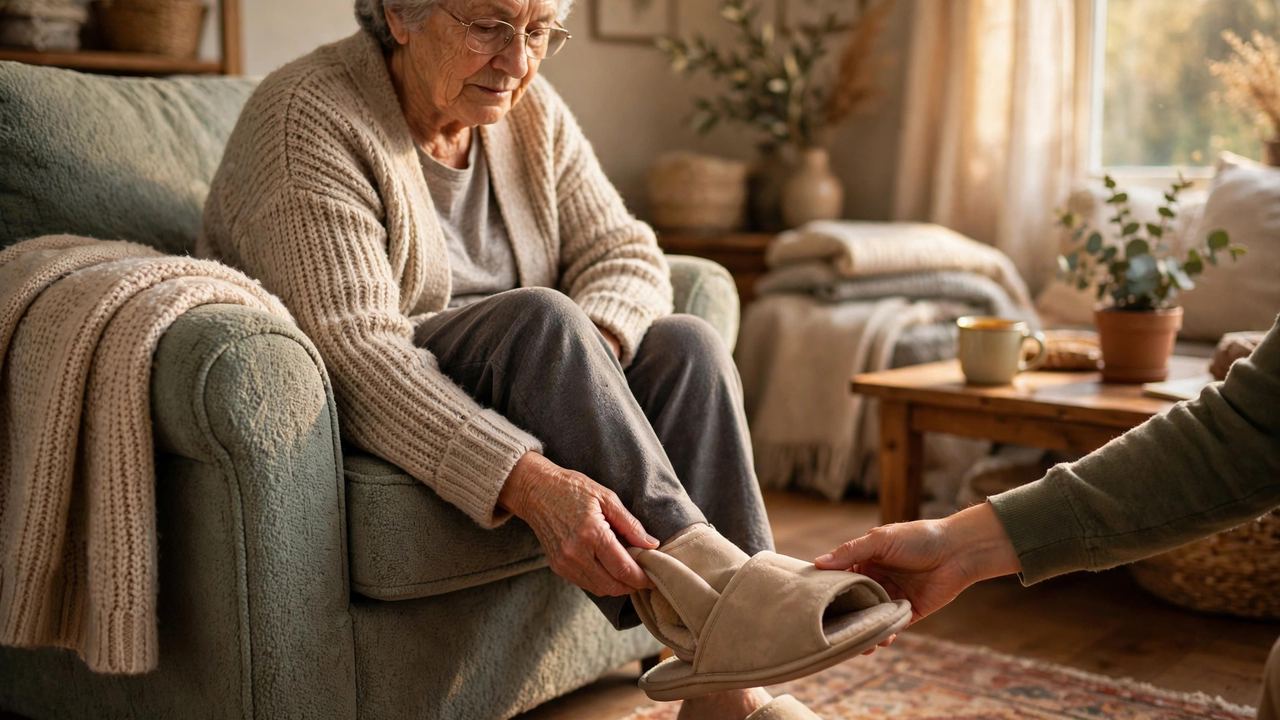
Think about the dressing routine. Who puts the slippers on, and where? A slipper that opens fully can be placed on a seated wearer’s foot without standing balance entering the equation. Seated dressing also argues for a defined heel pocket or heel lip that keeps the foot from sliding forward while the strap is fastened. If a caregiver dresses the wearer, closures on top of the foot — visible and reachable — beat closures at the side or back. Machine washability, a listed feature of the Silvert’s pick, matters more the more hours per day the slippers are worn.
Set honest expectations. No slipper treats Parkinson’s or guarantees against a fall, and you should be skeptical of any listing that promises otherwise. What a well-chosen slipper does is remove obstacles: it goes on without a struggle, stays on without toe-gripping, and meets the floor with a sole the maker designed for grip. Combined with clear walkways, good lighting, and support where the wearer’s care team recommends it, those small removals add up to a calmer daily routine. Replace slippers when the tread smooths out, the straps stop holding, or the upper stretches enough that the foot moves inside — a worn-out adaptive slipper quietly loses every feature that made it worth buying.
FAQ
What type of slipper is easiest to put on with limited hand dexterity?
A slipper with a wide or extra-large opening and a hook-and-loop strap, such as the Propet Cush ‘N Foot or the Orthofeet Charlotte, is generally the easiest: the top opens out of the way, the foot is placed rather than pushed in, and the strap fastens with a simple press that does not require pinch strength or tying.
Are backless mules a good idea for someone who shuffles?
They are usually the weakest choice. A backless style relies on the toes gripping to keep it on, and during short, shuffling steps it can slide forward, slip off, or catch on floor edges. A closed heel or a heel lip, as on the Dr. Comfort Cuddle and the Orthofeet Charlotte, keeps the slipper moving with the foot.
Can these slippers be worn with orthotics?
Several picks are built for it. The maker lists a removable orthotic insole and fitting spacers for the Orthofeet Charlotte, a removable footbed for both Propet Cush ‘N Foot models, and removable gel inserts with added depth for the Dr. Comfort Cuddle, so a personal orthotic can usually take the place of the included insert.
What if the wearer’s feet swell during the day?
Choose adjustability. Straps that can be loosened in the evening, stretch uppers like the Propet’s, and genuinely wide fittings like the Silvert’s bootie all accommodate changing volume. Avoid fixed elastic collars that cannot be adjusted, and consider sizing for the foot at its largest, then using straps or spacers to fine-tune the morning fit.
Should the sole be soft or firm?
For steadiness, a firmer sole with a non-skid or slip-resistant tread, as the makers list for these picks, is generally preferable to a thick, squishy foam sole. Cushioning belongs inside the slipper, under the foot; the outsole itself should feel stable and make full, predictable contact with hard indoor floors.
When should adaptive slippers be replaced?
Replace them when the outsole tread has worn smooth, when hook-and-loop straps no longer hold through the day, or when the upper has stretched so much that the foot shifts inside. At that point the slipper no longer provides the secure fit it was chosen for, even if it still looks presentable.
Conclusion
The right slipper for someone with Parkinson’s is the one that disappears into the routine: on without a fight, secure without effort, and steady on the floors that make up the day. The Orthofeet Charlotte and Asheville bring adjustable straps, closed designs, and removable insoles for women and men respectively. The Propet Cush ‘N Foot pair — women’s W0206 and men’s M0202 — offer the widest, easiest entry in the group with stretch uppers and single-strap closures. The Dr. Comfort Cuddle adds a padded closed heel and the maker’s gel inserts in a simple slip-on, and the Silvert’s Adaptive Diabetic Slippers go widest of all, with Easy Touch closures built for assisted dressing. Match the closure to the hands, the sole to the floors, and the fit to the foot at its largest, and a small daily task becomes a small daily comfort instead.
More from Amazon
Programs that pair well with the guide above. Offers and eligibility are set by Amazon and may change.
Collect the home and kitchen items you want in one registry that guests can shop from.
Create a wedding registrySet up recurring deliveries of everyday items on eligible products. Terms and savings are set by Amazon.
Explore Subscribe & SaveFree shipping on eligible items, Prime Video and more. Eligible new members can start with a free trial.
Start a Prime free trialAudiobooks and podcasts to listen to on the go. Eligible new members can start with a free trial.
Try Audible freeAs an Amazon Associate we earn from qualifying purchases.










Write Your Review
No reviews yet. Be the first to share your experience!